Month: October 2025

An Inspiring Feast Day

Today, October 22, is the feast day of Pope Saint John Paul II, marking his installation Mass in 1978 as the new Bishop of Rome. John Paul II was the first non-Italian pope elected in more than four centuries; and he served as Pope from October 16, 1978 until his death on April 2, 2005.

Known for his love of people, compassion, courage, and spiritual insight, Pope Saint John Paul II is remembered for his remarkable way of encouraging all people in their faith, wherever they were in their journeys. Here are some words from his homily in St. Peter’s Square, during his inaugural Mass:

“‘You are the Christ, the Son of the living God.’ (Matthew 16: 16) These words were spoken by Simon [Peter], son of Jonah, in the district of Caesarea Philippi. Yes, he [Peter] spoke them with his own tongue, with a deeply lived and experienced conviction — but it is not in him that they find their source, their origin: ‘… because it was not flesh and blood that revealed this to you but My Father in heaven.'” (Matthew 16: 17) They were the words of faith …

” … All of you who are still seeking God, all of you who already have the inestimable good fortune to believe, and also you who are tormented by doubt: please listen once again, today in this sacred place, to the words uttered by Simon Peter. In those words is the faith of the Church. In those same words is the new truth, indeed, the ultimate and definitive truth about man: the son of the Living God — ‘You are the Christ, the Son of the Living God.'”1

Pope Saint John Paul II guided us with the most loving care while he was with us in this world. He is also remembered today for his deep and unwavering conviction that Jesus is the only way, the only truth and the only life:

“Only in Christ can men and women find answers to the ultimate questions that trouble them. Only in Christ can they fully understand their dignity as persons created and loved by God. Jesus Christ is ‘the only Son from the Father…full of grace and truth.’”2 (John 1: 14)

May your hearts be filled with Jesus on this inspiring feast day.

1John Paul II. Homily of His Holiness John Paul II for the Inauguration of His Pontificate. The Holy See. October 22, 1978.

2John Paul II. World Youth Day, 1993. Denver, Colorado.

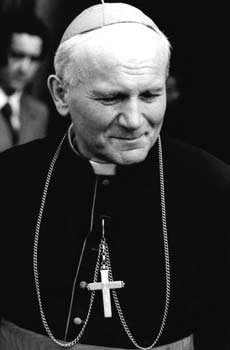
Photograph of Pope Saint John Paul II is courtesy of the Hulton Archive/Getty Images.  

Light and Life

The Incarnation of Christ — this mystery through which God, in the person of the Son, Jesus, becomes fully human while remaining fully divine — is evidence of God’s ongoing pursuit of our souls.

Jesus, who is both true God and true man, becomes the sole and timeless mediator between God and all humans. The Light and Life that Jesus brings into the world (John 1: 4-5) stands in stark contrast to the darkness and death that descended upon humanity when God’s creation freely chose death by eating the forbidden fruit in the Garden of Eden. (Genesis Chapter 3)

But if God is Love (1 John 4: 16) and truly desires to save the world from darkness and death through His Son, Jesus (John 3: 16), why do evil and violence continue to prevail in the world?

Habakkuk, a prophet who lived during the late seventh century B.C., is famous for asking God this very question:

“O Lord, how long shall I cry for help, and You will not hear? Or cry to you ‘Violence!’ and You will not save? Why do you make me see wrongs and look upon trouble?” Habakkuk 1: 2-3

Violence and evil are rampant when Habakkuk calls out to God. Clearly frustrated, Habakkuk boldly asks God how He can stand by and passively observe such evil? God answers through a vision that He asks Habakkuk to record:

“And the Lord answered me [Habakkuk], ‘Write the vision; make it plain upon tablets, so he may run who reads it. For still the vision awaits its time; it hastens to the end — it will not lie. If it seems slow, wait for it; it will surely come; it will not delay.” Habakkuk 2: 2-3

God doesn’t disagree with Habakkuk that things are bad. In fact God confirms that things are likely going to get worse for Habakkuk and his generation:

“For behold, I am rousing the Chaldeans, that bitter and hasty nation, who march through the breadth of the earth, to seize habitations not their own. Dread and fearsome are they; their justice and dignity proceed from themselves.” Habakkuk 1: 6-7

In light of this, God goes on to describe five woes to Habakkuk. These woes are pronouncements of judgment that are meant to condemn sin and to warn of its consequences:

Woe against Aggression: “Woe to him who heaps up what is not his own — for how long? — and loads himself with pledges! Will not your debtors suddenly arise, and those awake who will make you tremble? Then you will be booty for them. Because you have plundered many nations, all the remnant of the peoples shall plunder you, for the blood of men and violence to the earth, to cities and all who dwell therein.” Habakkuk 2: 6-8

Woe against Covetousness: “Woe to him who gets evil gain for his house, to set his nest on high, to be safe from the reach of harm! You have devised shame to your house by cutting off many peoples; you have forfeited your life. For the stone will cry out from the wall, and the beam from the woodwork respond.” Habakkuk 2: 9-11

Woe against Violence: “Woe to him who builds a town with blood, and founds a city on iniquity! Behold, is it not from the Lord of hosts that peoples labor only for fire, and nations weary themselves for nothing? For the earth will be filled with the knowledge of the glory of the Lord, as the waters cover the sea.” Habakkuk 2: 12-14

Woe against Inhumanity: “Woe to him who makes his neighbors drink of the cup of his wrath, and makes them drunk, to gaze upon their shame! You will be sated with contempt instead of glory. Drink, yourself, and stagger! The cup in the Lord’s right hand will come around to you, and shame will come upon your glory! The violence done to Lebanon will overwhelm you; the destruction of the beasts will terrify you, for the blood of men and violence to the earth, to cities and all who dwell therein.” Habakkuk 2: 15-17

Woe against Idolatry: “What profit is an idol when its maker has shaped it, a metal image, a teacher of lies? For the workman trusts in his own creation when he makes dumb idols! Woe to him who says to a wooden thing, Awake; to a mute stone, Arise! Can this give revelation? Behold it is overlaid with gold and silver, and there is no breath at all in it. But the Lord is in His Holy Temple; let all the earth keep silence before Him.” Habakkuk 2: 18-20

Violence and evil are still rampant today; and Biblical woes can provide us direction and hope. In particular, they offer both interpretation and application of God’s Holy Commandments. (Exodus 20: 1-20)

But let’s face it, Biblical woes can also be difficult and uncomfortable to read. Specific to Habakkuk’s story, I think the real danger is to dismiss the darkness described in the woes because it seems, somehow, beyond our reach. Are any of us committing sin on the scale described in Habakkuk’s vision? Maybe not. But the troubling thing about darkness and evil is that it so often begins on a small scale.

Who cares if I need a drink or two to get through my work day; isn’t that better than using harder drugs? I sure love collecting religious items, but is my focus on God or the thrill of finding these unique treasures? I may be spending 60-plus hours at work each week to avoid some problems, but would my brother really respond if I spent more time with him? I know that sometimes I lash out at my kids with my sharp tongue, but isn’t that better than physically hitting them? I spend a lot of time on social media and may end up on sites that take me down confusing paths, but my sense of reality isn’t blurred, is it? So what if I take office supplies from work for my home; my company makes so much money, what does it matter?

It’s helpful to read the woes revealed to Habakkuk with a broad lens, looking for the big and small ways that these behaviors show up in our lives.

It’s also helpful to remember that God shares these woes as reminders of His Mercy and Love. The woes provide a way for us to avoid sin and judgement through repentance and faith in Him. Habakkuk recognizes this and responds to God in a way that demonstrates renewed faith and hope:

“Yet I will rejoice in the Lord, I will joy in the God of my salvation. God, the Lord, is my strength; He makes my feet like deer’s feet, He makes me tread upon my high places.” Habakkuk 3: 18-19

Which brings me back to Jesus … and the Light He has brought into this world. ♥️

When you have difficult days, remember how much God loves us. If it feels like God is taking too long to respond, wait for Him — trust that He’s out ahead somewhere, preparing the path for you. Habakkuk’s story is one of countless stories in the Old Testament that reveal God’s endless quest to help us to live good and loving lives.

The entire New Testament is a stunning record of God’s decision to send His Beloved Son, Jesus, for the salvation of the world. This first coming of Christ was done in order that all who believe in Him “should not perish but have eternal life.” (John 3: 16) In the Book of Revelation, Jesus plainly tells us that He will be back:

“Surely, I am coming soon,” [says the Lord]. Revelation 22: 20

I love this verse in Revelation. It’s literally one of the last sentences of the Bible! I can’t help but marvel at the fact that it’s this promise that God chooses to close the Bible. God loves us and He does not intend for us to be alone or separated from Him. When Jesus returns the second time, God will establish a new heaven and a new earth, where He will eternally dwell with all the believers and redeemed, where there is no pain or sorrow or mourning. (Revelation 21: 1-8)

God loves us deeply and without end. Jesus is fighting for our souls, ready to offer His Love and Mercy and Forgiveness to all of us who desire it.

There is no sin or darkness that Jesus cannot overcome. On your darkest days, always know and trust in this truth. ♥️

“And the Spirit and the bride says, ‘Come!’ And let him who hears say, ‘Come!’ And let him who thirsts come. Whoever desires, let him take the water of life freely.” Revelation 22: 17

Grace and Truth

“In the beginning was the Word, and the Word was with God, and the Word was God. He was in the beginning with God. All things were made through Him, and without Him nothing was made that was made.

“In Him was life, and the life was the light of men. And the light shines in the darkness, and the darkness has not overcome it …The true light that enlightens every man was coming into the world. He was in the world, and the world was made through Him, yet the world knew Him not.

“He came to His own home and His people did not receive Him. But to all who received Him, who believed in His name, He gave power to become children of God; who were born not of blood nor of the will of the flesh nor of the will of man, but of the will of God.

“And the Word became flesh and dwelt among us, full of grace and truth; we have beheld His glory, glory as of the only-begotten Son from the Father … And from His fullness have we all received grace upon grace. For the law was given through Moses; grace and truth came to us through Jesus Christ.

“No one has ever seen God; but the only begotten Son, Jesus Christ, who is in the bosom of the Father, has made the Father known to us.” John 1: 1-5, 9-14, 16-18

And so we pray — Beloved Father, thank you for Your boundless love. Thank you for sending your beloved Son, Jesus Christ, to help us to see and fully receive the grace and truth of your Holy Commandments, which are meant to help us to live in goodness and in peace. Dearest Jesus, our Savior and Light, thank you for Your boundless mercy and for coming to dwell among us. You are the ONLY Way, the ONLY Truth, and the ONLY Life — the ONLY way home to the Father and to an eternal life filled with boundless love and joy and peace. Come, Holy Spirit, fill our hearts and minds and souls with the humility and desire to seek Jesus out every day, multiple times a day, so that we may be strengthened and made holy through His boundless love and counted among His flock. Amen.

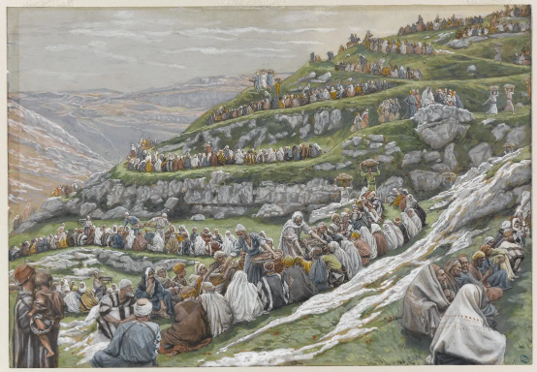
The Miracle of the Loaves and Fishes (1886-1896), which is part of James Tissot’s “The Life of Our Lord Jesus Christ” series, today hangs in Brooklyn Museum.

Lord, Help Us to Know You

In 2007, shortly after his election to the papacy in 2005, Pope Benedict XVI published a book titled, Jesus of Nazareth: From the Baptism in the Jordan to the Transfiguration.

In the book’s introduction, Pope Benedict describes that this book is in “no way an exercise of the magisterium, but is solely an expression of my personal search ‘for the face of the Lord’ (Psalm 27: 8).” (Foreword, p. xxiii)

These heart-felt words from a man who dedicated his life to God set the stage for an engaging and thought-provoking exploration of Jesus’ public ministry, including His baptism by John the Baptist, His Sermon on the Mount, the meaning of the parables, His calling of the twelve apostles, Peter’s confession and the Transfiguration.

This book is sitting near my keyboard as I write today’s post. My underlines and scribbled notes reflect how Pope Benedict effortlessly guides readers through historical-critical, Biblical and philosophical writings and perspectives. His writing compels readers to pause and think about what Jesus is trying to show humankind. The end result is a book that helps its readers to more clearly see Jesus “in light of His communion with the Father” (Foreword, p. xiv), which in turn reveals Jesus as the one path to truth and to God the Father.

One of Pope Benedict’s concerns, as he reveals in the Foreword, is that historical-critical scholarship in particular has distracted and divided us. Perhaps at times we have been so consumed by the debate that we focused more on winning the argument versus finding the answers. This distracts us from seeing and knowing Jesus as God intends — as “the Word [who] became flesh and dwelt among us, full of grace and truth … [and] the only-begotten Son from the Father.” (John 1: 14)

Is Pope Benedict suggesting that we abandon the practice of historical-critical thought and analysis? Absolutely not! Historical context and critical thinking matter immensely. When asked which is the greatest commandment in the law, Jesus said:

“You shall love the Lord your God with all your heart, and with all your soul, and with all your mind. This is the great and first commandment.” Matthew 22: 36-38

Jesus wants us to use our minds and to think deeply about what He is trying to show us.

But Pope Benedict asserts that this mental knowing cannot be a mere intellectual exercise. Knowing God with our minds must also be an experiential relationship that renews the mind to align our thoughts with God’s truths. To understand God’s Word and purposes is a process ultimately inspired and enabled by the Holy Spirit, transforming our desires and intentions to align with God’s Will.

Pope Benedict reminds us that historical-critical scholarship is merely one lens through which God is revealed to us. Another essential lens for knowing Jesus is the Bible itself.

I have heard people describe that the more we read the Bible, the more the Bible begins to read us. The very breath and life of God is in those sacred pages; and when we spend time alone with God there, He reads the questions on our hearts and minds. Through the intercession of the Holy Spirit, God guides us to the Bible stories and verses that provide the answers we seek.

One thing I greatly appreciate about Pope Benedict’s book is the reminder that we do not need to be Biblical scholars to read the Bible. While there are certainly moments within his book where Pope Benedict’s exegesis or interpretation of various texts is intense, he reminds us again and again that to know God and to better understand His ways, we simply need to desire a relationship with God, through Jesus. As we cultivate this relationship, our awareness and understanding of God grows.

Pope Benedict’s book memorably demonstrates how all of this works together. I regard his book as an unexpected combination of a man’s very personal diary with an impressive study guide that challenges us to go deeper and deeper into our exploration of who Jesus was and is and will be for all time. Over and again, as Pope Benedict explores varied texts for views of Jesus, he brings us back to the Bible, encouraging us to explore this most sacred text and to form our lasting views of Jesus and His holy communion with the Father there. Through the life, death and resurrection of Jesus, God bridges the Old and New Testaments in ways that bring mercy and peace and understanding and love … and “an intimate friendship with Jesus, on which everything depends.” (Foreword, p. xxiii)

Pope Benedict XVI published two more books — Jesus of Nazareth: Holy Week: From the Entrance into Jerusalem to the Resurrection and Jesus of Nazareth: The Infancy Narratives — creating a New York Times Bestseller three-volume series.

I am incredibly grateful for all of these books.

“Lord, help me to come to know You more and more. Help me to be ever more at one with Your will. Help me to live my life not for myself, but in union with You, to live it for others. Help me to become ever more Your friend.”
– Excerpt from a homily of Pope Benedict XVI, delivered approximately 60 years after his priestly ordination.