
Month: March 2026

God’s Promises, Fulfilled in Jesus

Centuries before the Birth, Passion, Death and Resurrection of Jesus, the prophet Isaiah wrote about the arrival of a humble but rejected Servant of God:

“For He grew up before him like a young plant,
and like a root out of dry ground;
He had no form or comeliness that we
should look at Him,
and no beauty that we should desire Him.

He was despised and rejected by men;
a Man of Sorrows, and acquainted with grief.”
Isaiah 53: 2-3

Isaiah and other Old Testament prophets and writers also made predictions about the life, death and resurrection of this long-awaited Messiah. In stunning form, all of their predictions were fulfilled in Jesus. Following are some of the amazing predictions made and fulfilled in Christ:

Conceived and born of a Virgin: “Therefore, the Lord Himself will give you a sign. Behold, a Virgin shall conceive and bear a son, and shall call His name Immanuel.” (Isaiah 7: 14, fulfilled in Luke 1: 26-35)

Born in Bethlehem: “But you, O Bethlehem Ephrathah, who are little to be among the clans of Judah, from you shall come forth for Me one who is to be ruler in Israel, whose origin is from of old, from ancient days.” (Micah 5: 2, fulfilled in Luke 2: 4-7)

Betrayed and sold for 30 pieces of silver: “Then the Lord said to me, ‘Cast it into the treasury’ — the lordly price at which I was paid off by them.” (Zechariah 11: 13, fulfilled in Matthew 26: 15)

Betrayal money used to buy a potter’s field, called the Field of Blood to this day: “Then I said to them, ‘If it seems right to you, give me my wages; but if not, keep them.’ And they weighed out as my wages 30 shekels of silver. Then the Lord said to me, ‘Cast it into the treasury — the lordly price at which I was paid off by them.'” (Zechariah 11: 12-13, fulfilled in Matthew 27: 5-8)

Silent when questioned and accused: “He was oppressed, and He was afflicted, yet He opened not His mouth; like a Lamb that is led to the slaughter, and like a sheep that before its shearers is silent, so He opened not His mouth.” (Isaiah 53: 7, fulfilled in Matthew 27: 11-14)

Condemned with criminals: “Therefore I will divide Him a portion with the great, and He shall divide the spoil with the strong; because He poured out His soul to death, and was numbered with the transgressors; yet He bore the sin of many, and made intercession for the transgressors.” (Isaiah 53: 12, fulfilled in Luke 23: 32-34 and Mark 15: 27)

Crucified and hung on a Cross: “Yes, dogs are round about Me; a company of evildoers encircle Me; they have pierced My hands and feet.” (Psalm 22: 16, fulfilled in Luke 23: 33 and John 19: 17-18)

Mocked as He is dying: “All who see Me mock at Me, they make mouths at Me, they wag their heads; ‘He who committed His cause to the Lord; let Him deliver Him, Let Him rescue Him, for He delights in Him!'” (Psalm 22: 7-8, fulfilled in Matthew 27: 39-44 and Luke 23: 35-39)

Suffered thirst when He is dying: “I am poured out like water, and all My bones are out of joint; My heart is like wax, it is melted within My breast; My strength is dried up like a potsherd, and My tongue cleaves to My jaws; You lay Me in the dust of death.” (Psalm 22: 14-15, fulfilled in John 19: 28-29)

Forsaken at the end of His Life: “My God, my God, why have You forsaken Me? Why are you so far from helping Me, from the words of My groaning?” (Psalm 22: 1, fulfilled in Matthew 27: 46

Died for our sins: “Surely, He has borne our griefs and carried our sorrows; yet we esteemed Him stricken, struck down by God, and afflicted. But He was wounded for our transgressions, He was bruised for our iniquities; upon Him was the chastisement that made us whole, and with His stripes [and sufferings] we are healed.” (Isaiah 53: 4-5, fulfilled in Mark 15: 37-39 and John 19: 30)

Pierced after His death: “And I will pour out on the House of David and the inhabitants of Jerusalem a spirit of compassion and supplication, so that, when they look on Him whom they have pierced, they shall mourn for Him, as one mourns for an only child, and weep bitterly over Him, as one weeps over a first-born.” (Zechariah 12: 10, fulfilled in John 19: 31-37)

Buried by a wealthy man: “And they made His grave with the wicked and with a rich man in His death, although He had done no violence, and there was no deceit in His mouth.” (Isaiah 53: 9, fulfilled in Luke 15: 42-47 and John 19: 38-42)

Raised from the dead: “Therefore my heart is glad, and my soul rejoices; my body also dwells secure. For You do not give me up to Sheol, or let your godly one see the Pit. You show me the Path of Life; in Your presence, there is fullness of joy, in Your right hand are pleasures for evermore.” (Psalm 16: 9-11, fulfilled in Matthew 28: 1-10 and John 20: 1-18)

It is beautiful and undeniable how the Old and New Testaments work together to demonstrate the deep mercy and love of God. Holy Weeks offers us a special opportunity to contemplate the fulfillment of God’s promises in and through Jesus, the Son of God. God is faithful and trustworthy in everything He promises (Psalm 145: 13).

The ancient prophets who were blessed to receive visions of the promised Savior each described Jesus in unparalleled detail and accuracy. No person other than Jesus has ever been described in such detail — and centuries before He arrived.

This should give us great confidence and joy that Jesus is exactly who He says that He is — the Way, the Truth and the Life. (John 14: 6)
Everything Depends on Love

Hours before His arrest, Jesus gathers His twelve disciples to share in a final meal together:

“Now before the feast of the Passover, when Jesus knew that His hour had come to depart out of this world to the Father, having loved His own who were in the world, He loved them to the end.” John 13: 1

Knowing full well the agony that awaits Him, Jesus is focused on the needs of His disciples, preparing them for their ministry and demonstrating once more His deep love for them. This is beautiful to contemplate.

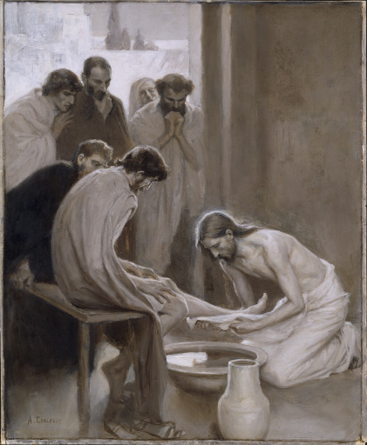
In the midst of supper, Jesus quietly rises from the table and does the unthinkable:

“Jesus, knowing that the Father had given all things into His hands, and that He had come from God and was going to God, rose from supper, laid aside His garments, and tied a towel around Himself. Then He poured water into a basin, and began to wash the disciples’ feet, and to wipe them with the towel that was tied around Him.” John 13: 3-5

This act causes quite a stir among the disciples. During Jesus’ time, roads in the Roman Empire, ranged from well-engineered stone highways (like the Via Maris) to rough, local dirt roads that were always dusty — and often muddy! A large basin of water was kept at the entrance to every Jewish home, so that feet could be washed before entering the home.

Normally, foot washing was delegated to the lowest ranking servant. Somehow, the disciples enter the home without having their feet washed. During the Last Supper, it is Jesus Himself who washes the feet of His friends. The disciples have come to recognize Jesus as the Messiah; and Simon Peter objects vehemently to Jesus washing his feet. But Jesus says to Peter:

“If I do not wash you, you have no part in Me.” John 13: 8

These words must have stirred Peter’s heart. Throughout His earthly ministry, Jesus has been telling the disciples and everyone else who will listen that our lives will be defined by the depth of our love for God and for each other. When a Pharisee asks Jesus which is the greatest commandment in God’s law, Jesus replies as follows:  

“And Jesus said to them, ‘You shall love the Lord your God will all your heart, and with all your soul, and with all your mind. This is the great and first commandment. And a second is like it, You shall love your neighbor as yourself. On these two commandments, depend all the law and the prophets.’” Matthew 22: 37-40

Everything — everything — depends on Love, Jesus tells us.

As Peter acquiesces and allows the Lord to wash his feet, he receives yet another profound lesson from Jesus about Love — the greatest virtue of Love is humility. Jesus shows Peter that only absolute humility enables absolute and perfect love of God and of others.

Do we fully grasp this?

St. Paul, in his first letter to the Church of Corinth, also underscores the virtue of humility as Love’s guiding force. The real power of Love lies not in our feelings or words. Rather, St. Paul describes that the power of Love is ultimately revealed in how we live and behave:

“Love is patient, and kind; love is not jealous or boastful; it is not arrogant or rude. Love does not insist on its own way; it is not irritable or resentful; it does not rejoice at wrong, but rejoices in the right. Love bears all things, believes all things, hopes all things, endures all things. Love never ends. (1 Corinthians 13: 4-8)

By washing His disciples’ feet, Jesus shows us that only when we are willing to make ourselves very small and little … only when we are willing to humble ourselves and allow someone else to be the master … can we love in the way that God intends for us to love.

Only God’s kind of Love — fueled by humility — has the power to transform souls. And as Jesus shows us, transformation occurs one soul at a time, through Love.

Our humility releases the power of God’s Love in our lives and in the lives of everyone we touch. St. Therese of Lisieux describes it this way:

“I am only a child, powerless and weak, and yet it is my weakness that gives me the boldness of offering myself as VICTIM [and channel] of Your Love, O Jesus! … In order that Love be fully satisfied, it is necessary that It lower Itself, and that It lower Itself to nothingness and transform nothingness into fire.1

After Supper, and after Judas Iscariot has left to betray the Son of God, Jesus says this to His disciples:

“A new commandment I give to you, that you love one another; even as I have loved you, that you also love one another. By this all men will know that you are My disciples, if you have love for one another.” John 13: 34-35

The hearts of Jesus’ disciples are no doubt burning so brightly. They have just witnessed Jesus wash their feet and institute the mysterious Eucharist. They have observed the betrayal of Judas and now fear what lies ahead for Jesus. The disciples’ hearts must be bursting with an indescribable love for their Friend and Teacher. In that moment, when the disciples’ hearts are most vulnerable, Jesus tenderly asks only that they love one another as He has loved them.

O, Precious Redeemer and Friend. ♥️

During these final two weeks of Lent, may we all reflect on the transformative power of loving the way that Jesus loves.

Jesus loves you so much. ♥️

“Above all things, have fervent and unfailing love for one another.” 1 Peter 4: 8

1 John Clarke, O.C.D., Story of a Soul: The Autobiography of St. Therese of Lisieux, Third Edition (Washington, DC: ICS Publications, 1996), 195.