
Let nothing disturb you. Let nothing upset you. Everything changes. God alone is unchanging. With patience and love all things are possible. Whoever has God lacks nothing. God alone is enough.
St. Teresa of Avila, Spain
Let nothing disturb you. Let nothing upset you. Everything changes. God alone is unchanging. With patience and love all things are possible. Whoever has God lacks nothing. God alone is enough.
St. Teresa of Avila, Spain
On my knees in the garden, I slowly turn the rich, fertile dirt with my hand shovel. The trees behind me are alive with an impromptu concert of birds singing their sweet songs. I hear the snap of a stick breaking and stop digging so that I can concentrate fully on listening. I close my eyes and remain still, with my back to the trees. A few more sticks snap as the Mama deer and her fawn draw closer to me. Our woods is their home during the summer, and I have come to know the sounds of the deer walking there.
I remain still and silent, with my back to the trees. Soon I hear the small warning snort from the Mama deer. She has spotted me in my garden. I hear the rush of their bodies running back through the woods and away from me. I smile as I think of their gentle beauty.
My thoughts turn then to you, Father, and the story of You walking in the Garden of Eden, looking for Adam and Eve:
“And they heard the sound of the Lord God walking in the garden in the cool of the day, and the man and his wife hid themselves from the presence of the Lord God among the trees of the garden. But the Lord God called to the man, and said to him, ‘Where are you?’ And he said, ‘I heard the sound of you in the garden, and I was afraid, because I was naked; and I hid myself.’ He [the Lord God] said, ‘Who told you that you were naked? Have you eaten of the tree of which I commanded you not to eat?’ The man said, ‘The woman whom you gave to be with me, she gave me fruit of the tree, and I ate.’ Then the Lord God said to the woman, ‘What is this you have done?’” Genesis 3: 8-13
A tragedy is unfolding there. You can hear the agony in God’s voice as He realizes that Adam and Eve have eaten from the tree of the knowledge of good and evil – the one tree from which He has forbidden them to eat. God has told Adam that if he eats from the tree, “you will surely die.” (Genesis 2: 15-17) As we know, later on, the serpent tricks Eve into believing that she will not die if she eats from the tree, but rather will become like God, “knowing good and evil.” (Genesis 3: 1-6)
We are witnessing the fall of humanity in these verses.
But take heart and look closely again at the Scripture verses above in italics. These verses reveal that before the fall, the sound of God walking in the garden was familiar to Adam and Eve. They knew the sound of God’s footsteps and of His voice. Perhaps the three met in the garden every day, in the coolness of the early evening, to enjoy the beauty of God’s creation. These verses undeniably reveal that in the beginning, God intended to have a direct and physical relationship with His creation. Let your heart contemplate this stunning reality for a moment.
Can you imagine hearing God’s footsteps drawing near to you? Or walking and talking with Him, outside among the trees and the birds, as the day closes? Can you imagine the sound of His voice? Or the sound of His laughter?
I treasure these verses in Genesis because they confirm that God wants a very personal and full relationship with us. He wants to love us and to be loved by us.
And yet from the very beginning of the Bible, within the Book of Genesis (the first book of the Old Testament), we are taught that the potential for love can only exist alongside the potential for rejection. True love can never be forced.
It is humbling to realize that even God – our Creator who forms us from the dust of the ground and literally breathes into our nostrils the breath of life (Genesis 2: 7) – cannot force us to love Him. God has given us the gift of free will. Because of this, the choice between death and immortality is set before each one of us.
We must consciously choose to love – to love the Father, and to love one another.
God understands that we do not always make good choices. It is striking to observe that as soon as sin enters the world through Adam and Eve, God introduces His plan for the gift of redemption:
“And I will put enmity between you and the woman, and between your offspring and hers; he will crush your head, and you will strike his heel.” Genesis 3: 15
For centuries now, Christian scholars and theologians have viewed this text as a foreshadowing of the Gospel of Jesus Christ – and in particular, of Jesus’ victory over Satan. From that moment onward, the world’s faithful have lived with the hope and promise of redemption.
God loves us so much. Despite what must have been His immense sadness over the choices made by Adam and Eve, Genesis 3 concludes with these words:
“The Lord God made garments of skin for Adam and his wife and clothed them. And the Lord God said, ‘The man has now become like one of us, knowing good and evil. He must not be allowed to reach out his hand and take also from the tree of life and eat, and live forever.’ So the Lord God banished him from the Garden of Eden to work the ground from which he has been taken. After He drove the man out, He placed on the east side of the Garden of Eden cherubim and a flaming sword flashing back and forth to guard the way to the tree of life.” Genesis 3: 21-24
I imagine tears streaming down God’s cheeks as he prepares some clothing for Adam and Eve. Shortly thereafter, God tells His beloved creation that they must leave the paradise He has created for them. After Adam and Eve leave the Garden of Eden, God then separates physically from His human creation. His daily walks and talks with Adam and Eve seem to end. The stories of the Old Testament testify to the agony of this self-imposed separation from God the Father.
And yet the promise and hope of redemption remains strong throughout the Old Testament. The ancient prophet Micah prophesies about God’s return to the physical earth, through His Son, Jesus:
“But you, Bethlehem Ephrathah, though you are small among the clans of Judah, out of you will come for me one who will be ruler over Israel, whose origins are from of old, from ancient times.” Micah 5: 2
The return of Jesus to the earth fulfills God’s promises of love and redemption.
I am sitting now in my garden, with my eyes on the path that leads into the woods. The journey of life, while beautiful, is filled with choices. The world can be a confusing place and not all choices are simple and straight-forward. We must all watch for the little signs from Jesus that appear everywhere. We must listen for the words that the Holy Spirit places on our hearts. And if we find ourselves becoming distracted and slipping away from God, we must go running back to Him.
He is always, always there waiting for us and loving us deeply.
I am praying, for you and for me, that throughout our lives, we experience the grace of holiness and love. I pray that at the end of our lives, we hear God’s footsteps quickening in the Garden, as He calls us each by name, to eternal life with Him.
I am forever grateful that we have Jesus to lead us home.
We are loved, deeply.
Jesus, the Good Shepherd
You are my trusted shepherd, Jesus, and because of this, there is nothing that I want. You prepare a resting place for me in green pastures and lead me beside quiet waters, and You restore my soul when I am sad and weary.
Jesus, you guide me plainly along the paths of goodness and light, and I follow you freely, for even the whisper of Your name brings me indescribable joy. I am not afraid, as I walk through the valley of darkness, for I know that You are with me; I am comforted by the knowledge that you will correct and guide me as I make my way.
You prepare a table before me, filling my heart with peace in the presence of those who would mock and hate me. You anoint my head with the finest of oil; my heart overflows with the knowledge of Your love for me. I am confident that your goodness and love will follow me, all the days of my life, and I long to dwell with you in Paradise, forever. Thank you for loving me, Jesus.
– Author’s adaptation of Psalm 23
When I find myself wanting to encounter God in a more direct way, I head outside. God is always there, waiting for me to find a place to sit and settle myself – and to let go of myself – so that He can fill up my ears with the sweet songs of the birds and the wisdom of the trees.
It is when I step away from myself and into nature that I am most able to observe His ways.
Mary Oliver, an American poet who won the National Book Award and the Pulitzer Prize, wrote tirelessly about the wonders of nature. Although she did not appear to prescribe to any particular religion, her writing became more and more spiritual as the years passed. She died in 2019, at the age of 83.
I cherish her poetry because over and again, she reminds her readers that the answers we seek are right before us, within our natural world. We just need to step outside and slow down – way down – and open our hearts to what God is trying to show us.
“At The River Clarion,” from Evidence, Poems by Mary Oliver1
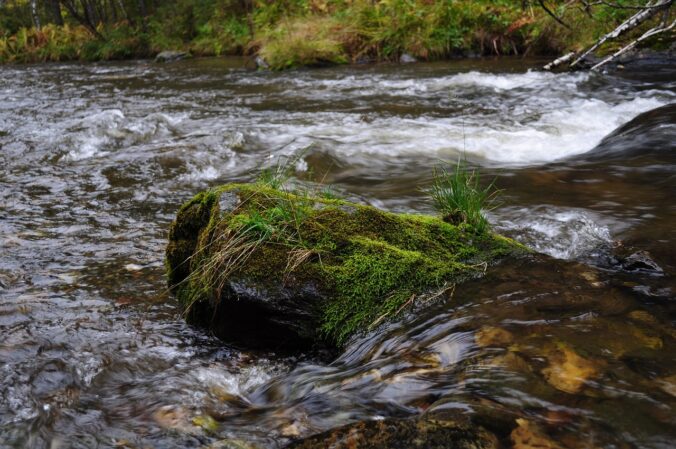
1. I don’t know who God is exactly. But I’ll tell you this. I was sitting in the river named Clarion, on a water splashed stone and all afternoon I listened to the voices of the river talking. Whenever the water struck the stone it had something to say, and the water itself, and even the mosses trailing under the water.
And slowly, very slowly, it became clear to me what they were saying. Said the river: I am part of the holiness. And I too, said the stone. And I too, whispered the moss beneath the water.
I’d been to the river before, a few times. Don’t blame the river that nothing happened quickly. You don’t hear such voices in an hour or a day. You don’t hear them at all if selfhood has stuffed your ears. And it’s difficult to hear anything anyway, through all the traffic, and ambition.
2. If God exists he isn’t just butter and good luck. He’s also the tick that killed my wonderful dog Luke. Said the river: imagine everything you can imagine, then keep on going.
Imagine how the lily (who may also be a part of God) would sing to you if she could sing, if you would pause to hear it. And how are you so certain anyway that it doesn’t sing?
If God exists, he isn’t just churches and mathematics. He’s the forest. He’s the desert. He’s the ice caps, that are dying. He’s the ghetto and the Museum of Fine Arts.
He’s van Gogh and Allen Ginsberg and Robert Motherwell. He’s the many desperate hands, cleaning and preparing their weapons. He’s every one of us, potentially. The leaf of grass, the genius, the politician, the poet. And if this is true, isn’t it something very important?
Yes, it could be that I am a tiny piece of God, and each of you too, or at least of his intention and his hope. Which is a delight beyond measure. I don’t know how you get to suspect such an idea. I only know that the river kept singing. It wasn’t a persuasion, it was all the river’s own constant joy which was better by far than a lecture, which was comfortable, exciting, unforgettable.
3. Of course for each of us, there is the daily life. Let us live it, gesture by gesture. When we cut the ripe melon, should we not give it thanks? And should we not thank the knife also? We do not live in a simple world.
4. There was someone I loved who grew old and ill. One by one I watched the fires go out. There was nothing I could do except to remember that we receive then we give back.
5. My dog Luke lies in a grave in the forest, she is given back. But the river Clarion still flows from wherever it comes from to where it has been told to go. I pray for the desperate earth. I pray for the desperate world. I do the little each person can do, it isn’t much. Sometimes the river murmurs, sometimes it raves.
6. Along its shores were, may I say, very intense cardinal flowers. And trees, and birds that have wings to uphold them, for heaven’s sakes – the lucky ones: they have such deep natures, they are so happily obedient. While I sit here in a house filled with books, ideas, doubts, hesitations.
7. And still, pressed deep into my mind, the river keeps coming, touching me, passing by on its long journey, its pale, infallible voice singing.
1Mary Oliver, “At the River Clarion,” in Evidence: Poems by Mary Oliver (Massachusetts: Beacon Press, 2009), pp. 51-54.
How do those of us who desire to know and love God find Him?
Moses, the leader of the Israelites in their exodus from Egyptian slavery and oppression and the faithful believer to whom God revealed His Ten Commandments, confirms that anyone who sincerely desires to know God can find Him, even if we have gone astray:
“The Lord will scatter you among the peoples, and only a few of you will survive among the nations to which the Lord will drive you. There you will worship man-made gods of wood and stone, which cannot see or hear or eat or smell. But if from there you seek the Lord your God, you will find Him, if you look for him with all your heart and with all your soul. When you are in distress and all these things have happened to you, then in later days you will return to the Lord your God and obey Him. For the Lord your God is a merciful God; He will not abandon or destroy you or forget the covenant with your forefathers, which He confirmed to them by oath.” Deuteronomy 4: 27-31
I relish these ancient words from Moses. Although we may not worship stone or wood idols today, all of us, at one time or another, have likely allowed things or people in our lives to become more important than our relationships with God. And yet even when this happens, Moses confirms that God is still willing to enter into — or re-enter — relationship with us. Why? Because His love and mercy for us is boundless.
So many of us who search for God expect that the journey to know Him will be arduous. Some of us travel to far distant lands, in search of God. Others spend years immersed in formal study. And still others participate in various bible studies or religious retreats. We join churches and participate in weekly worship. There is so much goodness in all of these things – and certainly, these activities can enable us to build relationships with other followers who seek to know God and to live holy lives. So these are all good things!
But we do not need to travel far or study long to find God. We do not need to wait for Sunday Mass to speak with God. We simply need to call for Him, from our hearts, and then await His reply. God is so near to each one of us. He wants to be a part of all of our days. He loves us and wants us to know His goodness. This is hard for us to understand.
Centuries after Moses lived, St. Paul, one of Christ’s earliest followers and missionaries, confirmed that God is, indeed, very near to all of us:
“The God who made the world and everything in it is the Lord of heaven and earth and does not live in temples built by hands. And He is not served by human hands, as if He needed anything, because He Himself gives all men life and breath and everything else. From one man He made every nation of men, that they should inhabit the whole earth; and He determined the times set for them and the exact places where they should live. God did this so that men would seek Him and perhaps reach out for Him and find Him, though He is not far from each one of us.” Acts 17: 24-27
St. Paul is plainly saying to us – Do you want to know Jesus? He has been waiting for you! Go to Him, right where you are, through your heart. Believe in Him. Listen for Him. Depend on Him. Trust what God places on your heart.
In the early 1930s, Saint Maria Faustina Kowalska captured these words from Jesus in her diary, as a young nun of the Congregation of the Sisters of Our Lady of Mercy in Poland:
“’I will tell you most when you converse with Me in the depths of your heart. Here, no one can disturb My actions. Here, I rest as in a garden enclosed.1’”
If you want to know God, find a quiet spot and listen for what He places on your heart.
God is waiting for you to seek Him.
Turn to Him each day, multiple times a day.
Never doubt how much God wants to be a part of your life.
“You will seek Me and find Me when you seek Me with all your heart.” Jeremiah 29: 13
1Saint Maria Faustina Kowalska, Diary of Saint Maria Faustina Kowalska: Divine Mercy in My Soul (Massachusetts: Marian Press, 2020), Verse 581, pg. 245.
In the Gospel of Matthew, Jesus confirms again that only in knowing and loving Him, will we find our purpose:
“’Anyone who loves his father or mother more than Me is not worthy of Me; anyone who loves his son or daughter more than Me is not worthy of Me; and anyone who does not take his cross and follow Me is not worthy of Me. Whoever finds his life will lose it, and whoever loses his life for My sake will find it.’” Matthew 10: 37-39
In this passage, Jesus is unequivocally telling his disciples that to live a life of purpose – to understand and embrace the plans that God has for each one of our lives (Jeremiah 29: 11-14) – we must place the pursuit of knowing and following Jesus above all else.
Still today, in our modern and noisy world, Jesus yearns to call each one of us to be His beloved disciple.
It is powerful and humbling to reflect on this. We are living in an era where self-interestedness and selfishness and inconsiderateness seem to be at an all-time high. People everywhere – myself included – seem to be on this never-ending search for the one thing that will make us fulfilled and happy.
What should we do with our lives? How can we make a difference? What will our legacy be?
We run through our days, chasing after things that so often merely exhaust us. The days of chase turn into months, and the months turn into years. And because we are so focused on ourselves, the hole within our hearts only grows larger.
But these words from Jesus ground me. They remind me that JESUS is the ONE THING I seek. His words encourage me to slow down and to turn to Him first, as I plan my days. His Words remind me that this search is not about me. Only Jesus can and will lead me to the God-given purpose for my life that I long for with my whole being.
As I read His words, I understand how much Jesus wants me to walk with Him. His Promise lifts me up because it reveals that the entire reason I am here is to seek Jesus, and to know His Love. It is that simple, and that profound.
He is standing beside me, as I type these words to you. He is standing beside you, as you read these words. His dreams and plans for both of us are so good … so beautiful.
Am I finally willing to lay down my own plans and to accept His greater plans for my life?
The choice is mine to make.
The choice is yours to make.
Jesus loves us so much.
A simple prayer for us:
Dear Holy Spirit, please work within our hearts, so that Jesus remains the sole object of our desires. Please reside within our minds, filling us in particular with greater patience and humility. Please call us to sit quietly with Jesus every day and to open our souls fully to the love and dreams He yearns to share with us. Please lead us to Jesus, Holy Spirit.
When Jesus’ time on earth following His resurrection was through, He gathered His eleven disciples on a mountain, to bid them farewell, and to remind them of their mission now on earth. They likely gathered on the Mount of Olives, a mountain range just east of the city of Jerusalem. For 40 days, the Risen Jesus had been with His beloved disciples, and now He was leaving them, to return to the Father.
As His disciples began to understand that Jesus was leaving, they naturally asked what would happen next:
“’Lord, will you at this time restore the kingdom to Israel?’ He [Jesus] said to them, ‘It is not for you to know times or seasons which the Father has set by His own authority.’” Acts 1: 6-7
This answer must have troubled the disciples. If Jesus was leaving, and the kingdom was not going to be restored, what was the point of all this? Why had Jesus been crucified and then raised from the dead, if things were going to remain the same on earth?
To make things even more personal – Why were the disciples being left behind? What was their purpose now?
But Jesus had an amazing plan for His beloved disciples, which He described as follows:
“’But you will receive power when the Holy Spirit has come upon you; and you will be My witnesses in Jerusalem, and in all Judea and Samaria, and to the ends of the earth … All authority in heaven and on earth has been given to Me. Go therefore and make disciples of all nations, baptizing them in the name of the Father and of the Son and of the Holy Spirit, [and] teaching them to observe all that I have commanded you.’” Acts 1: 8, Matthew 28: 18-20
Jesus had a plan for His disciples to take over the world. The plan had nothing to do with overthrowing the Roman Empire or the religious elite. Instead, those who had come to know Jesus as friend and Savior would conquer the hearts of men and women and children, heart by heart – and heart to heart. Their “weapon” would be the knowledge and experience of God’s deep, deep mercy and forgiveness. They would draw the hearts of people to God by sharing His Love.
In what is often called the “Great Commission,” Jesus provides a purpose and direction for His followers.
Jesus had taught His disciples that Love was the greatest of the Commandments. He had clearly explained and demonstrated to His followers that loving God and loving one another (Matthew 22: 34-40) were the greatest things they could do on earth.
Jesus taught that it is Love that transforms us and gives meaning to our lives:
“Only love has meaning – it raises up our smallest actions into infinity.1”
It is Love that first draws us to Jesus. As we grow in His Love and trust in His Mercy, Jesus strengthens and compels us to share His Love and Mercy with those around us, heart to heart, and “to the ends of the earth.”
As Jesus was taken up to Heaven, following His Resurrection, He made this promise to His beloved followers:
“’And behold, I am with you always, to the close of the age.’” Matthew 28: 20
Jesus makes this very same promise to His beloved followers today. He makes this promise to you, and to me. If we can accept and trust in His promise, we will begin an adventure with Him like none other we have experienced.
In knowing and loving Jesus, we too will find our purpose.
A prayer of Thomas Merton:
“I am afraid, Holy One, my Lord, of how exposed I feel when I think of walking even further into the unknown, into You. There is another side to the mountain. I haven’t seen it. I may never see it, but I desire to reach that other side. My help is in You. You will keep my foot steady. And in this silence, where you meet me, I know that You are like the shade at my right hand.2” Psalm 121: 2, 3, 5
1Saint Maria Faustina Kowalska, Diary of Saint Maria Faustina Kowalska: Divine Mercy in My Soul (Massachusetts: Marian Press, 2020), Verse 502, pg. 216.
2John Kirvan, Series Editor, Come into the Silence: 30 Days with Thomas Merton (Indiana: Ave Maria Press, 2021), pg. 58.
Katie Davis Majors is an American missionary and a self-described “lover of Jesus.” In December of 2006, Katie traveled to Uganda for the first time, as an 18-year-old. Less than a year later, she returned to Uganda and in 2008, she founded Amazima Ministries. The word “Amazima” means “truth” in the Luganda language.1
Katie is also the author of several books. The following words are taken from her first book, Kisses from Katie: A Story of Relentless Love and Redemption. I picked up this book years ago in an airport, shortly after it was published. Her words have stayed with me:
“The big God of small details loves each one of us so intimately, created each of us in His image. Each one of us is cherished. How would life change if we thought of each other as such? If each person who approached us we treated as beloved of God, cherished by God, one of God’s favorite people? The God of the universe delights in you. In me. In them. Could we rest in that? Could we love like that? 2” – Katie Davis Majors
How might we live, if we loved and trusted like this?
1© 2022 Katie Davis Majors. All Rights Reserved. https://katiedavismajors.com/amazima
2Katie Davis with Beth Clark, Kisses from Katie: A Story of Relentless Love and Redemption (New York: Howard Books, 2011), p. 268.
When I reflect on the New Testament stories about the Risen Christ, I am always struck by the image of Jesus running after His disciples. Jerusalem is abuzz with His Crucifixion – the city is obsessed with a man claiming to be the Son of God. Although Pilate has dispatched extra security to guard the tomb of Jesus, the grave is now empty! What is happening?! Who is in charge? Government officials and religious leaders alike are on edge, trying to maintain some semblance of control. The disciples, fearing for their own lives, have scattered.
In the midst of this chaos, the Risen Jesus goes running after His disciples, wanting them to understand everything that has happened. When Jesus first appears to his Eleven disciples, this is what He says:
“’Why are you troubled, and why do questionings arise in your hearts? See My hands and My feet, that it is I Myself; handle me, and see; for a spirit has not flesh and bones as you see that I have.’ And when He had said this, He showed them His hands and His feet. And while they still disbelieved for joy, and wondered, He said to them, ‘Have you anything to eat?’ They gave Him a piece of broiled fish, and He took it and ate before them.” Luke 24: 37-43
As the Risen Jesus returns to His disciples, He spends time helping them to connect these recent events to Scripture and to the visions of the ancient prophets:
“’These are My words which I spoke to you, while I was still with you, that everything written about Me in the law of Moses and the prophets and the psalms must be fulfilled … you are the witnesses of these things.’” Luke 24: 44, 48
At this point, Jesus’ disciples must decide whether they will believe Him. They must decide to let go and to surrender to the plans Jesus has for them, and for all of us:
“’Truly, truly I say to you, he who believes in Me will also do the works that I do; and greater works than these will he do, because I go to the Father.’” John 14: 12
As Andrew Greer and Randy Cox so aptly describe in their memorable book Winds of Heaven, Stuff of Earth, the prospect of surrender can be difficult and confusing:
“Surrender’s definition often gets entangled with the modern implications of being submissive (which, when skewed, can enable oppression). But submission within healthy parameters – or within divine permission – advances genuine freedom. The privilege of surrender is the liberation to simply (though often self-complicatedly) let go. When we finally relinquish our obsessions, our pride, our white-knuckled need to control, we unbind the chains and unlock the door to our true potential, benefitting not only ourselves but also our entire circumference of community.1”
I love their words: “The privilege of surrender is the liberation to simply … let go.”
So I return to the Sea of Tiberias, by the morning fire Jesus has prepared on the shore. It is here that we witness the powerful surrender of Peter.
Jesus asks Peter three times, “Simon, son of John, do you love Me?” (John 21: 15-17) His questioning of Peter is notably reminiscent of the scene in the high priest’s court where Peter denies knowing Jesus three times, following Jesus’ arrest in Jerusalem. (John 18: 15-18, 25-27) There is no doubt that Jesus is testing the resolve of Peter to carry on His earthly mission of redeeming souls.
But Jesus also knows that His beloved friend and confidant, Peter, is still distraught over the fact that he actually denied knowing Him. Because of this, I imagine that Jesus also showers Peter with much mercy, that morning. As Peter affirms his love for Jesus three times over, perhaps Jesus has this to say:
I love you so much, Peter. Let go of that scene in the high priest’s court, and drop all that shame you feel over what happened. Forget it. I know that is not who you are – everyone sitting around this fire knows that. There was so much chaos and confusion after I was arrested. Things were moving so quickly. You did not even fully understand all these things that had to happen. But now you see and understand everything. So let go of the past, and move forward with Me, okay?
Peter and all the disciples must have been filled with such joy and relief, as they spoke with Jesus that morning. Their hearts and minds must have just been bursting with the knowledge of how much Jesus loves them. In witnessing the forgiveness and surrender of Peter, they understood that they, too, could trust in the Divine Mercy and Love of Jesus.
Jesus loves all of us so much. Trust in His Mercy. Surrender your ideas and plans to Him and let Jesus help you to pick out the pieces that can be combined with His ideas to create the most goodness.
I was so afraid of surrendering my heart to God at first. I feared that I was not good enough for Him. I feared that I would fail Him, or myself, or others. The truth is that there are days when I still fear all these things. When my fear rises up, I run right back to Him. This is all part of our journey, learning to navigate the uncertainties of our lives and our faith, while surrendering the things we hold deeply within our hearts.
It is hard to wrap our minds around the fact that God will never stop loving us. Here on earth, we regularly experience the loss of love. This Easter season, I hope Jesus increases, within each of us, our understanding of His Divine Mercy and Love. One of the last things Moses tells us, right before he dies, is that God will never leave us nor forsake us. (Deuteronomy 31: 6) Within that same passage, Moses also reminds us to be strong and courageous.
Can we trust in the Mercy and Love of Jesus?
Are we ready to let go of the things that keep us from knowing Jesus more deeply?
“I believe our behavior, no matter how abhorrent, could never capture the essence of who we are, nor could any achievement, no matter how glorious, fully characterize how much we are loved. So give it up, my friend. The shame you carry from those relationships and circumstances that were in and out of your control – hand it over. The trophies you worked so hard to earn in order to obtain favor and acceptance from your peers, your family, from yourself – lay them down. They are not who you are. Through the practice of surrender we discover the stunning perspective of heaven – we are beloved by God.2”
Jesus loves you so much.
1Andrew Greer and Randy Cox, Winds of Heaven, Stuff of Earth (Tennessee: Worthy Inspired, 2017), 126.
2Ibid, 127.
As the Easter season continues, the Resurrection of Jesus remains on my heart. In particular, I find myself thinking about Simon Peter, or Peter.
The New Testament provides four lists of Jesus’ first twelve disciples:
Within all four lists, the same twelve men are named – and the first name to appear in all of the lists is “Simon, whom He named Peter.” (Luke 6: 14) “Peter” was a nickname, so to speak, given to Simon by Jesus. In its Greek form, “Petros” is a proper name signifying “a stone, a rock, a ledge or cliff; used metaphorically of a soul hard and unyielding.1” Peter’s prominent position within the lists of early disciples, coupled with his nickname, signifies his role as leader and spokesman for the group.
Peter was a fisherman by trade. He had not received much formal education or training (Acts 4: 13), and yet Jesus calls Peter to be a “fisher of men.” (Matthew 4: 19) One of the most well-known of the twelve disciples, his love for and commitment to Jesus was undeniable. Peter was also headstrong and emotional. Not shy about asking Jesus questions, Peter also had a tendency to speak before thinking, which sometimes led him to say foolish things. Despite being one of Jesus’ closest confidants – remember, Peter was one of the three disciples who witnessed the stunning Transfiguration of Jesus high upon a mountain (Mark 9: 2-13) – Peter could also be weak in his faith. It is Peter who denies knowing Jesus three times, following Jesus’ arrest in Jerusalem. (Mark 14: 66-72)
So many of us can relate deeply to Peter – I know that I do.
The early days following the Resurrection must have been incredibly intense for Peter, as he strives to keep the other disciples calm and focused, all the while trying to reconcile within his own heart and mind what has happened to Jesus’ body, following the Crucifixion and Burial.
Mary Magdalene is the first to discover that Jesus is missing from the tomb. She reports this to Peter, who races to the tomb, along with John. The Gospel of John describes the scene in riveting detail:
“Peter then came out with the other disciple [John], and they went toward the tomb. They both ran, but the other disciple outran Peter and reached the tomb first; and stooping to look in, he saw the linen [burial] cloths lying there, but he did not go in. Then Simon Peter came, following him, and went into the tomb; he saw the linen cloths lying, and the napkin which had been on his [Jesus’] head, not lying with the linen cloths but rolled up in a place by itself. Then the other disciple, who reached the tomb first, also went in, and he saw and believed; for as yet they did not know the Scripture, that He [Jesus] must rise from the dead. Then the disciples went back to their homes.” John 20: 3-10
Brave Peter is the first to enter the empty tomb of Jesus. He does not find a tomb in disarray, which frankly would have been indicative of a robbery or mischief. Instead, Peter finds the linens and tomb to be in an orderly manner. In particular, the linen that covered Jesus’ head is neatly folded, in a place by itself, much as a house guest might leave their bed linens following an overnight stay. My parish priest recently reminded us that Jesus and his twelve disciples had been traveling together for three years. Peter would have known how Jesus tended to His personal items. We can only imagine the thoughts racing through Peter’s mind and heart, as he takes in the scene within the empty tomb.
Later that same day, in the evening, Peter and the disciples are together behind locked doors, for fear of the Jews. Jesus suddenly appears to the disciples:
“Jesus came and stood among them and said to them, ‘Peace be with you.’ When He had said this, He showed them His hands and His side. Then the disciples were glad when they saw the Lord.” John 20: 19-20
Jesus’ initial visit with His beloved disciples seems brief, but we know that this is the first of several appearances Jesus will make. He is trying to give His earliest disciples the knowledge and support needed to continue their earthly mission of drawing souls to God. Jesus is clear, on that first day, about the Father’s intent:
“Jesus said to them again, ‘Peace be with you. As the Father has sent Me, even so I send you.’” John 20: 21
Shortly thereafter, Jesus leaves the disciples; but we deduce from the Bible that Jesus likely spends His remaining days on earth engaging with other disciples as well. A few days ago, I recounted the story of Jesus’ appearance to Cleopas (or, Clopas) and another unnamed disciple who is believed to have been Cleopas’ wife, Mary. The Gospel of John identifies Mary as “the wife of Clopas” (John 19: 25), at the foot of Jesus’ cross. While Cleopas and Mary dine with Jesus, they suddenly recognize Him and understand that He is helping them to connect recent events with Scripture and the Old Testament prophecies. Cleopas and Mary immediately return to Jerusalem, to report what has happened to Peter:
“And they rose that same hour and returned to Jerusalem; and they found the Eleven gathered together and those who were with them, who said, ‘The Lord has risen indeed, and has appeared to Simon!’ They [Cleopas and Mary] told what had happened on the road [to Emmaus], and how Jesus was known to them in the breaking of the bread.” Luke: 24: 33-35
Given Peter’s leadership role in the establishment of the early Church (Matthew 16: 17-19) – a role designated by none other than Jesus Himself – we can only imagine Peter’s joy in observing Jesus calling his most ardent disciples back to Him, so that they may become true apostles in this beautiful, shared mission.
The wonder of it all takes our breath away.
To share one last scene involving Peter and Jesus, after the Resurrection – there is the appearance of Jesus to the disciples by the Sea of Tiberias in Galilee. Peter and the disciples have been waiting for Jesus there. Worried and perhaps a bit disappointed that His arrival has been delayed, they set out one evening to do some fishing. Their fishing is not productive until at last, Jesus arrives on the scene:
“Just as day was breaking, Jesus stood on the beach; yet the disciples did not know that it was Jesus. ‘Children, have you any fish?’ They answered Him ‘No.’ Jesus said to them, ‘Cast the net on the right side of the boat, and you will find some.’ So they cast it, and now they were not able to haul it in, for the quantity of fish. That disciple [John] whom Jesus loved said to Peter, ‘It is the Lord!’ When Simon Peter heard that it was the Lord … [he] sprang into the sea, [to swim to shore].” John 21: 4-7
When Peter and the disciples arrive on shore, they find Jesus by a small fire, with fish and bread cooking over the charcoal. Jesus asks the disciples for some of the fish they have caught, adding their catch to the fire. I love this gesture of Jesus. Obviously, He can provide more than enough fish and bread for the disciples’ breakfast. But Jesus wants the disciples to contribute to the meal. They have worked hard that night to tow their catch to shore. Jesus is clearly signaling to the disciples – and to all of us – His strong desire and need to work with us, in bringing His Word out into the world.
Jesus also does not need our help in cultivating believers. If He wanted to, Jesus could override our free wills and draw us to Himself, forever. But that’s not how life with Jesus works. Jesus wants us to choose Him, and to choose God the Father. This is why we have been given the precious gift of a free will.
As we begin to love and trust in Jesus, we are each asked by Him to share that love and understanding with others.
Breakfast by the Sea of Tiberias concludes with Jesus reminding Peter of his new mission on earth:
“Jesus said to Peter the third time, ‘Simon, son of John, do you love Me?’ Peter was grieved because Jesus said to him the third time, ‘Do you love Me?’ And Peter said to Jesus, ‘Lord, you know everything; you know that I love you.’ Jesus said to him, ‘Feed My sheep.’” John 21: 17
Through this scene, Jesus is reminding us all of our shared mission as believers.
I cherish these glimpses of Peter – the imperfect disciple forever transformed by the Love of Christ.
May this beautiful Easter season with Jesus bring transformation within each of our imperfect hearts as well.
“And after this Jesus said to Peter, ‘Follow Me.’” John 21: 19
1THAYER’S GREEK LEXICON, Electronic Database. Copyright © 2002, 2003, 2006, 2011 by Biblesoft, Inc. All rights reserved. Used by permission. BibleSoft.com
It is Jesus in fact that you seek when you dream of happiness; He is waiting for you when nothing else you find satisfies you; He is the beauty to which you are so attracted; it is He who provokes you with that thirst for fullness that will not let you settle for compromise; it is He who urges you to shed the masks of a false life; it is He who reads in your hearts your most genuine choices, the choices that others try to stifle. It is Jesus who stirs in you the desire to do something great with your lives, the will to follow an ideal, the refusal to allow yourselves to be grounded down by mediocrity, the courage to commit yourselves humbly and patiently to improving yourselves and society, making the world more human and more fraternal.
St. John Paul II, 15th World Youth Day, Prayer Vigil Address, August 19, 2000
© 2026 Stepping Stones To Grace
Theme by Anders Noren — Up ↑








Recent Comments